Everything about your very first stamp is a mystery if you’ve never stamped before. There is a lot to learn, from the initial stamping to the final finishing. It can be intimidating to get started with leather stamping because there are so many unknowns. But the more you stamp, the more comfortable you will become. Soon you’ll be able to tell when you need to add or subtract weight from your strike, or when you need to move to the next tool in the series. You will gain an understanding of the depth you prefer in your impressions, how hard you like your leather, and your preferred style. And that is completely fine. The best way to learn is by doing. Start simple, with just your name, and go from there. If you find that you enjoy it, you can invest in more stamps and continue practicing your craft.
With all the different tools, styles, and factors that go into leather stamping it can be daunting to get started, but the truth is, it’s a skill that you can develop with time and practice. You likely won’t be starting with a full collection of stamps, but rather a few basic shapes, so pick up a small piece of veg-tan leather and get practicing. You’ll quickly learn that it’s less about the tool and more about the force and technique you use to apply it. Your first impressions might be too light or too deep, but as you practice you’ll get a sense of the moisture level, force of strike, and positioning that work best for you. Don’t try to make your first impressions perfect, instead try to be consistent. Stamp the same border a few dozen times so that your hand gets used to the feel and your eye starts to recognize when something is off before you strike. With the muscle memory you build in the basics you’ll be able to approach more intricate designs.
As you become more comfortable, you will probably start to combine stamps to create borders, corners and a few small flowers. At this point, you are probably going to start to pay attention to negative space and the arrangement of elements on a page. It is a pleasant surprise the first time you successfully stamp a border around a rectangular block without gaps or overlaps, and you realize how far you’ve come. You’ll still make mistakes. You might get a stamp crooked or some of the ink might be too wet. But now, instead of being frustrating, those are just little issues you need to resolve for the next piece. If you use a notebook or phone to document each of your practice pieces, you’ll be able to actually see your improvement, even when it seems like you’re not making progress from day to day.
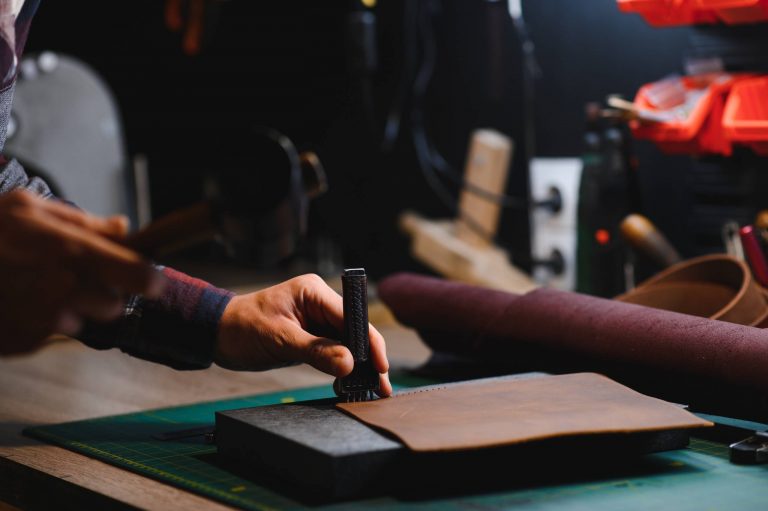
Once we progress to bevelers and background tools, we are taking steps to create actual relief in the leather. Bevelers are challenging because you have to apply different amounts of pressure and determine the direction in which you should be beveling so the beveled area looks like it is rising out of the leather and not beveled at an angle. Background tools are simply a matter of endurance, as you want to texture the entire background without too much texture in any one area. Some people find this process soothing as you are just tapping away and the sound lulls you into a state of peace. And once you tool the leather correctly, you can feel the nice smooth bevels against the dimpled background, and it encourages you to tool more!
Once technical mastery is achieved, individual personality is naturally expressed. Some prefer a geometric style with repetition and a graphic design that requires accuracy and order, while others lean more towards florals with stems and leaves that involve more interpretation and abstraction. Additionally, the option to apply dye to work after stamping allows for further artistic decisions as the color may enhance the depth or distort it into something different. At this stage, the creations become functional items such as wallets, journal covers, and keychains with practical and personal value. If the end result is well-received by others or by oneself, one will feel good about the time spent and be inspired to pursue more challenging designs.
While this process isn’t ever really over, there is a shift when you go from ‘nervous newbie’ to ‘seasoned stamper.’ Things that used to take you hours of struggling to figure out take minutes to accomplish and projects that felt daunting become ‘routine’ as you follow the steps you already know to complete them. It still isn’t easy, but you look forward to the struggle because you have a strong base to build from. With every new project you complete you draw upon the experience you have gained along the way. This connection from one project to another means leather stamping isn’t just a hobby, it’s a long term friend in the creative and making process.